The Fortress and the Bridge
Power and indispensability are not the same thing.
The United States can remain an immense economic, military and technological power while the rest of the world’s dependence on its systems weakens.
An alternative currency does not need to replace the dollar to change the balance of negotiation. Affordable artificial intelligence does not need to surpass the best models to become commercially sufficient. And a region does not need to cut itself off from the world to seek greater autonomy.
But a contradiction appears: as societies try to protect themselves behind their own economic and technological borders, some also become more dependent on what they cannot produce alone — future generations, talent, knowledge and trust.
A reflection on power, its limits and the paradox of civilizations that seek to become more independent without being able to stop depending on one another.
Contents7 sections
- Introduction — When power no longer guarantees control
- Part One — Indispensability is eroding, not superiority
- Part Two — Security can no longer be bought with force alone
- Part Three — People, the dependence that cannot be relocated
- What would invalidate this argument
- Conclusion — The fortress and the bridge
- Notes and references
Introduction — When power no longer guarantees control
The most revealing lesson of the confrontation with Iran lies neither in the number of facilities destroyed nor in the number of missiles intercepted. It lies in a less spectacular reality: the persistent difficulty of guaranteeing commercial passage through the Strait of Hormuz.
The United States has military capabilities without equal against Iran. And yet, in early October 2026, traffic through the strait fell to its lowest level in more than two months. The causes add up: hostilities, attacks on ships and the American blockade of Iranian ports. On October 11, the United States again stopped a commercial vessel attempting to run that blockade. An operation can achieve its military objective while imposing considerable costs on world trade.
This is not a first. During the “Tanker War” of the 1980s, and again in the Red Sea from late 2023, vastly superior Western navies patrolled the area. Yet in January–February 2024, the volume of trade passing through the Suez Canal fell by about 50% year on year, according to the IMF. Ships did not return when the threats were intercepted. They return when insurers agree to cover them and shipowners judge the risk bearable.
An aircraft can destroy a launch ramp. It cannot force an insurer to accept a risk, or an investor to commit capital for ten years. Confidence has become part of the infrastructure, and it cannot be produced by force.
This gap between capability and control extends beyond the military domain. For centuries, Western powers accumulated advantages in navigation, industry, finance, science and then digital technology. Those advantages did not only create wealth. They defined the arrangements through which the rest of the world did its business.
None of those advantages has disappeared. But we must distinguish two things that are often confused: being superior and being indispensable. The argument of this essay is that the second form of power is eroding faster than the first.
A country does not need to beat the American banking system to reduce its dependence on it: it only needs reliable alternatives for part of its trade. A company does not need the best AI model: it only needs one that is good enough and affordable. An adversary does not need to match a military budget: it only needs to impose costs. The alternative does not need to be superior. It only needs to be sufficient.
The essay develops this idea in three stages. The first part examines the erosion of indispensability in finance and technology. The second shows why economic security can no longer be bought with military power alone. The third deals with the dependence no country can relocate: people. A short final section sets out what would invalidate this argument.
The grip can loosen without the hand that holds it losing its strength.
Part One — Indispensability is eroding, not superiority
1. Productive power and systemic power
Economic power has two sources. Productive power is what a society actually creates: goods, services, research, infrastructure. Systemic power appears when a country’s currency, standards and networks become necessary to the functioning of others.
The United States has both in abundance. But they do not follow the same logic. The first depends on what a country does. The second depends on what others cannot do without it.
Imagine that the United States kept its universities, its factories and its companies, but that the rest of the world settled a growing share of its trade in other currencies. The American economy would remain immense. On the other hand, the structural demand for dollar assets, the capacity to sanction and the rents drawn from proprietary ecosystems would diminish. That is the difference between a strong economy and an economy at the center of everyone else’s system.
2. Finance: exclusivity matters more than market share
The dollar remains central. According to the IMF, it accounted for about 56.7% of allocated foreign exchange reserves in the second quarter of 2026. Its position rests on the depth and liquidity of American markets, on their legal framework and on powerful network effects.
The long-term trend is nonetheless clear. At the end of 2000, the dollar accounted for 70.5% of those reserves. Central banks bought more than 1,000 tonnes of gold each year from 2022 to 2024, then another 863 tonnes in 2025, a level that remains historically high. Russian and Chinese officials state that most of their bilateral trade is now settled in roubles and yuan.
The strongest objection must be faced: in finance, liquidity is the product. A “sufficient” currency is not sufficient if nobody else uses it. SWIFT is only a messaging network, and a competing messaging system recreates neither the depth of the Treasury market nor the global stock of dollar contracts. These network effects explain why the dollar’s share is declining slowly rather than abruptly.
But the objection only concerns dominance, not leverage. A supplier serving 90% of a market keeps considerable influence. That influence changes in nature when the remaining 10% offers a real possibility of exit. Alternatives change the balance of negotiation long before they become dominant.
For a country that fears sanctions or an asset freeze, these alternatives are worth far more than their transaction cost. They are strategic options. A state can keep using the dollar for most of its trade while maintaining a backup channel for its vital commerce.
History suggests the likely pace. Sterling lost its central role over several decades, between the First World War and the 1960s, even as the United Kingdom remained a great power. The loss of exclusivity is a long process, not a collapse.
3. When the world no longer needs the best
Markets do not always reward maximum sophistication. They reward the balance between performance, cost, reliability and real need.
Apple thrives at the high end thanks to its ecosystem. But for many users, a Xiaomi is enough to communicate, take photographs, pay and navigate. The cheaper product does not have to match every function of the premium one. It only has to cover the ones that matter to its buyer.
This logic now reaches artificial intelligence. According to the Stanford AI Index 2026, American private investment in AI reached about $286 billion in 2025, far ahead of any other country. It has produced models capable of complex reasoning and scientific work.
But what level of intelligence does the customer need? A small business wants to manage its bookings and reconcile its invoices. A manufacturer wants to detect defects. A public administration wants to classify documents and translate. These uses demand reliability and integration, not necessarily the frontier model.
And the price of a given level of performance is collapsing. According to Stanford, the cost of inference at comparable performance fell by a factor of more than 280 between November 2022 and October 2024. Open models are progressing fast, but their catching up is neither permanent nor uniform: in March 2026, the gap with the best closed models had widened again, to 3.3%. The cost of frontier development remains colossal, while the cost of sufficient intelligence is falling quickly, at the risk of shrinking the margins the most sophisticated suppliers hope to draw from their superiority.
AI could therefore become extremely valuable to society without generating proportional returns for those who financed the frontier. Value could shift toward infrastructure providers, toward integrators, or directly toward users. Geopolitically, the consequence is simple: the dominant supplier can remain the best and stop being indispensable.
4. The disappearing interface and the new gatekeepers
If intelligence becomes cheap, where does power reside? Part of the answer lies in how we will use it.
During the digital era, users adapted to machines: keyboards, menus, applications, passwords. The smartphone was the culmination of that architecture. But the value never lay in the screen. It lay in the result. Someone who opens a travel app does not want to browse menus. They want to leave.
AI makes it possible to shorten the distance between intention and execution. One could ask an earpiece, glasses or a voice-driven phone to find a flight, book it and send the itinerary. We would move from an attention economy to an execution economy.
This transition would weaken the advantages tied to elaborate interfaces, prestige devices and platform loyalty. It is a new form of sufficiency: what the customer pays for is a completed task, whatever the sophistication of the tool.
But it also creates a new mandatory checkpoint. The assistant that chooses on the user’s behalf decides which services are selected, which prices are shown and which options remain invisible. The old gatekeepers of the digital world could lose their influence to new ones. The disappearance of the screen does not guarantee the disappearance of power.
Not every activity will become voice-driven: engineering drawings, medical imaging and financial comparisons still require visual interfaces. The likely transition is not the end of screens, but the end of their necessity for every ordinary interaction.
5. One dependence can replace another
The assistant example illustrates a more general trap. Technologies that reduce one dependence can create another.
A company that does without several intermediaries thanks to AI becomes dependent on a cloud or chip supplier. A government that digitizes its services acquires unprecedented surveillance capabilities. Russia, by detaching itself from the Western financial system since 2022, has above all increased its dependence on China, for its payments as for its components.
Sanctions can therefore accelerate the search for alternatives without producing independence. Sovereignty does not consist in being able to change supplier. It means understanding the consequences of that choice, keeping several options open and preventing an essential function from becoming hostage to a single relationship.
The world that is emerging is therefore not one of self-sufficient powers. It is one of negotiated interdependence: the systems remain, but their terms of use are increasingly open to renegotiation.
Part Two — Security can no longer be bought with force alone
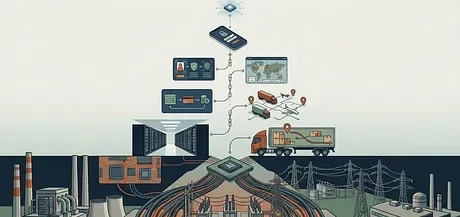
6. The physical economy beneath the digital world
A financial transaction crosses continents in milliseconds. The goods it pays for still require energy, transport, ports, labor and time. The digital era was right to value information. It was wrong to conclude that our dependence on the physical world was shrinking.
Semiconductors show this better than any other sector. At the heart of the digital economy, they depend on specialized minerals, ultra-pure chemicals, rare machines, stable electricity and global logistics. In March 2026, attacks in the Gulf disrupted Qatari production of gas and helium, an indispensable input at certain stages of manufacturing. The factories did not stop producing, thanks to their stocks. But the episode was a reminder of the material foundations of a technology we think of as immaterial.
The rise of AI reinforces this dependence. Data centers require electricity, cooling, land, equipment and technicians. The more sophisticated the technology, the more demanding its industrial dependencies.
No great power escapes this reality. Russia has resources but lacks advanced electronics. China has exceptional industrial depth but depends on imported energy and maritime trade. The United States depends on specialized foreign suppliers. Europe faces its own fragilities in energy, critical materials and demography.
Total self-sufficiency is therefore a mirage. An economy is not strong because it produces everything at home. It is strong when it knows its critical dependencies and has alternatives if one of them gives way.
7. The economics of asymmetric disruption
Technological superiority does not guarantee economic efficiency. In the Red Sea, CSIS noted Houthi drones costing around $2,000 shot down by SM-2 missiles costing around $2 million each.
The comparison calls for caution. A drone is not a ballistic missile, and an expensive interceptor is justified to protect a ship and its crew. But the structural problem remains. If the attacker produces threats more cheaply than the defender can stop them, the defender must spend more, invent cheaper defenses, accept more risk or strike at the source. Each option has its limits.
This matters above all for economies rich in high-value civilian assets: refineries, airports, desalination plants, ports, power grids. The attacker does not need to destroy them. It only needs to make their operation uncertain. This is disruption without occupation: an intact port that ships avoid, an open airport that airlines route around.
Hormuz illustrates this problem better than any other passage. Its geography is fixed, and there is no alternative route for most Gulf cargoes. A powerful navy reduces the risk. It does not eliminate it. The effects then spread to Asian manufacturers, to European prices and to the purchasing power of importing households.
Markets adapt: stockpiles, new suppliers, diverted routes. But resilience is not free. Trade that survives thanks to higher insurance premiums, strategic reserves and duplicated infrastructure is not the same as predictable, cheap exchange. Globalization can continue, but at a higher operating cost.
8. Strategic crossroads
Some economies are more exposed than others to this reality: those that live from flows.
The Gulf built its transformation on energy, but also on aviation, logistics, finance and expatriate labor. A crossroads economy creates value by attracting passengers, goods, capital and talent. Its security is therefore not only military. It is a condition of its economic model.
Prolonged insecurity affects flights, insurance, tourism and the arrival of professionals, even if the infrastructure remains intact. That is why a well-armed commercial state can judge that avoiding escalation is indispensable to its development.
The same reasoning applies to the countries of North Africa and the Mediterranean that want to become bridges between Europe and Africa. Their strength lies less in choosing one economic sphere than in their ability to connect several. The fortress seeks to minimize exposure. The crossroads creates value by mastering it.
9. Peace as an economic calculation
For countries whose prosperity rests on connectivity, peace is not only a moral aspiration. It is an economic asset.
This does not make defense useless. Credible deterrence reduces the probability of an attack. But no realistic defense system can protect every piece of infrastructure against every cheap threat. There is a limit to the security that military spending can buy.
Beyond that limit, economic security depends on the management of political relationships. Defense and diplomacy are not alternatives. A government that wants to attract investment over several decades cannot organize its strategy around the next confrontation alone.
Part Three — People, the dependence that cannot be relocated
The multiplication of financial, technological and commercial alternatives could encourage the world’s major regions to organize their development more around their own institutions. But this new autonomy contains a contradiction. States can relocate factories, diversify their suppliers or build strategic reserves. They cannot relocate a generation that has not been born. And while some societies seek to reduce their external dependencies, their ageing could make them even more dependent on the international movement of people, skills and knowledge.
10. The demographic contradiction
The figures on ageing give the measure of this contradiction.
According to the OECD, member countries had on average about 33 people aged 65 or over for every 100 people aged 20 to 64 in 2025. That ratio could reach about 52 in 2050. An ageing society needs caregivers, technicians, engineers, teachers and taxpayers, just as smaller cohorts enter the labor market.
Responses exist: productivity, employment of older workers, retirement age, support for families, automation. All of them matter. But demographic renewal is measured in decades, not quarters. For immediate shortages, immigration remains an important variable, even if it cannot resolve ageing on its own.
The contradiction is not unique to the West. China, Japan, South Korea and Russia are ageing even faster than the United States, whose demography differs markedly from that of Germany or Italy. But it strikes directly at the societies tempted to withdraw: they seek autonomy at the moment they most need others.
11. When leaving becomes a choice
Income gaps long drove migration toward rich economies. They were never the only reason: freedom, security, education and family mattered too. But host countries could attract talent because the opportunities they offered were hard to find elsewhere.
One might conclude that the development of the rest of the world will dry up these flows. Reality is more nuanced. Work on the “migration hump”, notably by Michael Clemens, shows that emigration often increases when a poor country becomes middle-income. More people then have the means to leave. Development does not reduce mobility at first.
What changes is the balance of negotiation. An Indian engineer, a Brazilian researcher or a Nigerian entrepreneur can now compare several credible destinations, including staying at home. They are no longer fleeing an absence of opportunity. They are choosing between several futures.
For host countries, attractiveness is no longer a given. A foreign student weighs tuition fees, the cost of living, visas, safety, social welcome and the possibility of settling after graduation. A skilled worker compares housing, healthcare, taxation and stability.
The United States hosted about 1.18 million international students in 2024–2025. Their value goes far beyond tuition fees: they feed research, entrepreneurship and long-term networks. Scientific ecosystems are built cumulatively. A university does not live on its past successes, but on its continuing ability to attract exceptional people.
A more precise signal concerns artificial intelligence itself. According to the Stanford AI Index 2026, the number of AI researchers and developers moving to the United States has fallen by 89% since 2017, including 80% in the last year studied. That figure concerns only this flow of specialists, not skilled immigration as a whole. And the United States retains the world’s largest concentration of AI talent. But the gap between that stock and that flow illustrates exactly the argument of this essay: a country can remain the leader while attracting fewer and fewer of the people who renew its lead.
The status of a center of opportunity becomes something that must be earned continuously, rather than an inheritance.
12. Renewal behind the walls
A society does not renew itself only by replacing its retirees. It renews itself through the meeting of knowledge, experience and ideas it would not have produced alone.
Human mobility has always carried more than labor. Merchants spread techniques, mathematics and crops. Students came home with new intellectual traditions. The traveler often returns with far more than what prompted the departure.
A country that retains its talent is making real progress. But there is a difference between no longer needing to leave and no longer having a reason to travel. The first is progress. The second signals stagnation.
Migration also has costs: pressure on housing and services, distributional tensions, legitimate questions of integration. The question is whether societies can manage them without cutting off the exchanges through which they learn. The danger of the fortress is not only that it excludes those outside. It is that it gradually excludes whatever it does not already know.
13. Can AI replace the missing generations?
It will be objected that AI and robotics will make this dependence less pressing. The argument deserves to be taken seriously: automation can support medical diagnosis, logistics, administration and the independence of older people.
Three limits remain. First, care, construction and emergency response require physical presence and human trust. Second, productivity does not by itself improve public finances: if the gains go mainly to capital and labor income weakens, the financing of social protection must be rethought. Finally, AI itself depends on electricity, hardware and skilled technicians.
More fundamentally, human beings are not only units of production. A civilization needs people to start families, keep institutions alive, create culture and pass on experience. Machines can help sustain production. We cannot assume they will reproduce the social effects of human exchange.
What would invalidate this argument
To evaluate this argument, it is not enough to look for events that seem to confirm it. We must also watch for developments that could limit its reach. If alternative systems remain marginal, if technological advantages stay durably exclusive and if the major institutions keep their capacity to attract capital and talent, the hypothesis of a structural erosion of indispensability will have to be re-examined. The indicators to watch are these:
- The dollar’s share of world reserves stabilizes, and central bank gold purchases fall back to pre-2022 levels.
- Alternative payment systems remain marginal outside countries under sanctions.
- Frontier AI labs keep their pricing power, and the gap between frontier models and open models widens instead of narrowing.
- Western navies restore normal traffic in contested straits without a lasting rise in insurance premiums.
- Western universities and employers maintain their share of students and skilled workers from India, China and Africa.
These indicators are partly independent: none of them alone is enough to confirm or refute the argument. It is their overall direction that will show whether network effects and superiority are still enough to guarantee indispensability, or whether the grip is indeed loosening without any single signal showing it spectacularly.
Conclusion — The fortress and the bridge
Faced with these changes, the most natural temptation is the regional fortress. After wars, the pandemic, energy shocks and sanctions, protecting essential capabilities seems reasonable. A country that depends on a single supplier for its medicines or its energy is dangerously exposed.
But the language of protection spreads easily. A policy aimed at a critical component becomes a general distrust of trade. The protection of sensitive infrastructure becomes a restriction on scientific cooperation. Border management becomes hostility toward foreigners. At that point, autonomy turns into isolation.
The fortress also runs up against human geography. Europe, Africa, Asia and the Mediterranean are not homogeneous civilizations, and their knowledge was built through encounters. The likely order is not one of sealed blocs, but of overlapping regional systems, corridors and competing standards.
International institutions will have to adapt. The UN, the financial institutions and the alliances will not disappear, but they will no longer be able to count on the absence of alternatives. They will have to prove their usefulness. The goal should not be to replace one exclusive system with several incompatible monopolies, but to build cooperation that remains legitimate because participation brings real value.
Influence therefore changes in nature. It depends less on the capacity to exclude than on the capacity to convince others that the relationship is worth keeping. A power that abuses coercion accelerates the search for alternatives. A power that offers reliable cooperation can keep its influence without exclusive control. This holds for Washington and Brussels, but also for Beijing, Moscow and the Gulf capitals.
The pace of these changes will be uneven. The advantage of an AI model can erode in a few months. The role of a currency evolves over decades. Demography changes over generations. Countries will become more technologically autonomous while remaining financially dependent, or more productive while becoming less attractive to researchers.
Nothing allows us to say that history has already chosen between a world of cooperating regions and a world of suspicious fortresses. What is certain is that the most advanced technology does not abolish geography, that the most powerful army does not guarantee confidence, and that a currency does not remain indispensable because it once was.
A fortress can defend the wealth accumulated behind its walls. It cannot, on its own, create the knowledge, trust, people and relationships on which future prosperity depends.
The grip may be loosening. It remains to be seen whether those who held it, like those who are freeing themselves from it, will understand that the alternative to domination is not separation, but a more conscious and more deliberate interdependence.
Notes and references
Main sources:
- Reuters — Shipping disruption in the Strait of Hormuz, October 8, 2026
- IMF — Data on world foreign exchange reserves, September 30, 2026
- Stanford University — AI Index Report 2026
- OECD — Pensions at a Glance 2025
- Institute of International Education — Open Doors 2025
Other data cited:
- IMF, COFER statistics: dollar share of allocated foreign exchange reserves, 70.5% at the end of 2000.
- World Gold Council: net central bank gold purchases, 2022–2025.
- U.S.-China Economic and Security Review Commission: settlement of Sino-Russian trade in national currencies, 2024.
- IMF, PortWatch: trade volume through the Suez Canal, January–February 2024.
- CSIS: comparative cost of Houthi drones and SM-2 interceptors.
- Stanford HAI, AI Index 2025 and 2026: inference cost, gap between open and closed models, mobility of AI talent.
- Michael Clemens, work on the “migration hump” (IZA). Other studies reach different results depending on methods and periods.
- Barry Eichengreen, work on the decline of sterling as a reserve currency.
- Reuters, October 11, 2026: a commercial vessel stopped while attempting to run the American blockade of Iranian ports.
Author’s note — This essay extends ideas developed in The Quiet Fracture of Globalization, The Quiet Transformation of Our World, The Wall of Systems and The Returners.
Read next
Follow Karim Spring
Free · no ads