The Day the Dam Finally Broke
When years of waiting give way, and life suddenly becomes an adventure again.
A rabbit steps into a green field after days of rain. A few careful steps, then a run, a leap. Nothing is chasing it — the field is open, and moving through it is a pleasure.
The list of things he wants to try grows faster than he can write it down. A hundred doesn't seem greedy at all — and the best part is, he doesn't have to finish it.
You wake up one morning the way you have thousands of times before. The room is familiar, the light through the window ordinary. You reach for your phone expecting the usual: messages, obligations, maybe another reminder of something that has stayed unresolved for far too long.
Instead, there’s an answer you’ve been waiting on for months. A situation that seemed permanently stuck has come loose. You read the message twice, looking for the catch. There isn’t one.
Then a second message. A negotiation that kept ending nowhere has produced an agreement. Before you’ve absorbed that, a third piece of good news arrives.
It feels as though life changed direction while you were asleep.
For years, life had felt like a long season of rain. Not a miserable life. There were good friends, real achievements, plenty of laughter. You kept working and making plans. But underneath all of it, the rain kept falling and the water kept rising.
Maybe it was a decision sitting in someone else’s hands. A test result, a legal matter, a stack of paperwork moving through some office at its own pace. A family rift that resurfaced every holiday, or a plan that couldn’t move until circumstances changed. None of it was a catastrophe, and each thing on its own was manageable. Together, over years, they took up far more room than you realised. They were the water behind a dam you had stopped seeing.
This is one of the strange talents of human beings: we adapt not only to our surroundings but to our burdens. A trip gets postponed, a project shelved, an invitation declined because there’s too much going on. The days aren’t empty, but the horizon quietly shrinks, until you notice you’ve stopped imagining what you’d like to do and started organising your life around what still needs fixing.
You get good at living this way. Patient, practical, always one step ahead of the next problem. And because the effort never stops, you eventually mistake it for the normal texture of life.
Then comes that morning.
The first piece of news is welcome. The second is a relief. By the third you’re smiling, and something larger than the individual events begins to happen. The conversations you’d rehearsed in your head will never need to take place. The explanations you’d prepared are suddenly unnecessary. The matters that filled your quiet moments for years are simply over.
The dam cracks, and before you quite understand what’s happening, it gives way.
It’s a peculiar thing to discover how heavy something was only once you’ve put it down. The relief is almost physical. Your shoulders drop. Your thoughts untangle. And an energy you’d half forgotten comes back, not gradually, but with the speed of something that had been waiting for permission.
Suddenly you want to do things. Not because they’re useful or expected, but because they’re interesting and you can. You remember a book you set down three years ago, a language you once meant to learn, an idea you dropped because there was never room for it. Why not take a train somewhere for no particular reason? Why not finally throw that dinner?
One idea wakes up another. A trip suggests a second destination; a forgotten interest turns into a project. Ten things you’d like to try become twenty, then fifty, and a hundred stops seeming greedy. The best part is that you feel no obligation to finish the list. It’s enough to discover how many things you’re curious about.
This isn’t about making up for lost time, or recovering some younger version of yourself. You don’t feel younger and don’t need to. Those years gave you judgment and a clearer sense of what matters, and they belong to you, with everything they brought and everything they cost. And yet, after all of it, life feels as if it has only just begun.
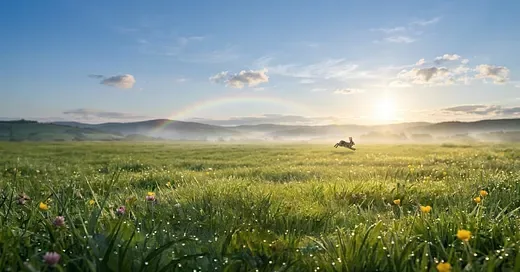
Picture a rabbit coming out into a wide green field after days of rain. The clouds have opened, the grass is wet and bright, the air smells of earth. It pauses, surprised. Then a few careful steps become a run. It stops, leaps, swerves, races toward another patch of grass. Nothing is chasing it. Nothing requires it to hurry. The field is simply open, and moving through it is a pleasure.
Maybe that’s closer to happiness than most of our elaborate definitions of success: the plain delight of being fully engaged in life.
Streets you’ve walked for years look different. You notice the shape of a building, the colours in a garden, the café you’ve passed a hundred times and never entered. You take the long way home because the weather’s nice. You browse a bookshop without looking for anything in particular. You sit down with a coffee and realise that, for the first time in ages, you aren’t rehearsing the next problem. You’re just there, and it’s wonderful.
It reaches other people, too. You call a friend just to hear her voice. You accept an invitation without first calculating everything that might stop you from going. You listen better and laugh more easily, not because anyone around you has changed, but because you’re finally all the way present with them. An ordinary dinner turns into an evening you’ll remember.
The dam hadn’t only been holding back your own happiness. It had been limiting how much of yourself you could give to anyone else.
Even the past shifts. Some memories had stayed tangled up with unresolved questions: decisions you kept second-guessing, chances you missed, disappointments still shaping your expectations.
You don’t forget any of that, and you don’t decide every hardship was secretly a blessing. Life isn’t a neatly built story in which each difficulty exists to set up a happier chapter. Some experiences simply cost us things we’d rather not have lost.
But their weight changes. You can remember the hard years without living inside them, and recognise mistakes without being defined by them. The past becomes something you carry forward rather than somewhere you keep returning.
The future looks different too. Tomorrow isn’t just another round of managing what’s left over from yesterday. Even uncertainty changes character: alongside everything that might go wrong, you start imagining the unexpected invitation, the lucky coincidence, the person you haven’t met yet.
That doesn’t mean every hour has to be extraordinary. One of the pleasures of this state is an afternoon that serves no purpose except making you happy. Ambition returns, but differently. You’re no longer trying to prove life hasn’t beaten you. You want to take part because taking part has become exciting, and success is something to enjoy rather than a condition that must be met before happiness is allowed.
Contentment with what’s here and appetite for what’s next turn out not to compete. You can love where you live and still want to travel. You can treasure the people around you and still be curious about the ones you haven’t met.
The intensity of those first days will settle, of course. The miraculous solutions become ordinary facts. New problems will come; breaking one dam doesn’t mean there will never be another. But something stays: the memory of that lightness, and the knowledge that it’s possible.
After years of rain, the world is open again. And there you are, in the middle of that wide green field, with no need to hurry and a hundred wonderful directions in which you might choose to run.
Keep a copy · View and download the PDF
Read it online, with the 2-minute overview, translations and the other essays:
karimspring.com/essays/the-day-the-dam-finally-broke/© 2026 Karim Spring. This copy is for your personal reading. New essays by email, free: karimspring.substack.com
Read next


Follow Karim Spring
Free · no adsAfter years of waiting on things outside your control, three pieces of good news arrive in one morning. What happens when the weight you stopped noticing is suddenly gone?
- The long season of rain. Not a miserable life, just many manageable burdens that, together, quietly shrank the horizon.
- The dam gives way. Relief arrives almost physically, and an energy you had half forgotten comes back at once.
- A hundred things to try. Curiosity returns faster than you can list it, and you don’t have to finish the list.
- Open to others again. The dam had also limited how much of yourself you could give to anyone else.
- The past and the future change weight. Hard years can be remembered without living inside them; tomorrow stops being leftover management.
“After years of rain, the world is open again.”The essay goes further · Start reading ↓