Chapter 2 · opening
The War of Mentalities
Where civilizations no longer clash at borders but fracture from within.
The most consequential conflicts of our time are not being fought primarily over territory, resources, or rival political systems in the classical sense. They are being fought over something harder to map and harder to resolve: the question of what it means to live with dignity in a world that is integrating faster than most societies can absorb, and whose terms of integration were set by others. What appears on the surface as a dispute over borders, trade agreements, or security arrangements often conceals something deeper — anxieties about recognition, about the survival of ways of life, about whether a civilization’s sense of itself can be preserved when the economic and cultural pressures of globalization systematically reward conformity to norms it did not author and does not fully accept. These are not peripheral concerns that material progress will eventually dissolve. They are the animating force behind some of the most durable and dangerous conflicts of the present century.
To understand them requires a different kind of analysis than the one most geopolitical frameworks provide. The dominant traditions of international relations — whether realist, liberal, or constructivist — were built to explain conflicts between states competing for power, wealth, or institutional influence. They are less well-equipped to explain why a society that has achieved significant economic development can still generate deep currents of political rage, or why communities that have gained material security can still feel the kind of civilizational threat that mobilizes collective identity in its most defensive and sometimes most destructive forms. The answer lies in a dimension that these frameworks tend to underweight: the civilizational dimension — the ways in which communities define the good life, remember their histories, and imagine their futures in relation to other communities who define these things differently.
This chapter examines that dimension directly. It takes as its starting point an observation that is simple to state but difficult to act upon: that the struggle between what might be called “soul” and “bread” — between the imperatives of cultural and spiritual integrity on one side and the material demands of economic survival on the other — is not a temporary transitional problem that modernization will resolve. It is a permanent structural tension in the lives of communities navigating global integration, and the way different societies manage it tells us more about the likely trajectory of geopolitical conflict than most conventional analysis allows.
The historical record gives this observation weight. The late nineteenth and early twentieth centuries produced multiple versions of the same collision: societies encountering the power and the cultural assertiveness of Western-led modernity and forced to answer, often under conditions of colonial subjugation, what they were willing to preserve and what they were willing to abandon. The answers varied enormously — ranging from wholesale embrace to violent rejection to the various hybrid syntheses that most societies actually produced — but the question itself was structurally identical. What has changed in the twenty-first century is not the fundamental nature of the tension but its scale, its speed, and the technological infrastructure through which it is now prosecuted. A conflict that once unfolded through pamphlets, sermons, colonial edicts, and the slow diffusion of ideas across physical space now unfolds through digital platforms that can mobilize identity, amplify grievance, and accelerate radicalization across borders in hours. The war of mentalities is an old war fought with new weapons in a new arena.
The concept of a war of mentalities — as distinct from a war of interests or a war of ideologies — captures something important about the specific character of contemporary civilizational conflict. It is not primarily a competition between states pursuing rational interests, though state power is very much involved. It is not primarily a clash of ideological systems in the Cold War sense, though ideas are deeply at stake. It is something more intimate and more volatile: a contest over which frameworks for understanding reality, which definitions of dignity, and which visions of the human good will shape the lives of communities that increasingly cannot avoid each other. This contest is fed not primarily by poverty — the evidence that poverty alone drives radicalization or civilizational conflict is remarkably weak — but by humiliation: the experience, whether individual or collective, of being seen as less than fully human, less than fully capable, less than fully deserving of the recognition that modernity promises to all and delivers unevenly.
Understanding how this contest operates requires moving across multiple levels of analysis simultaneously, from the structural to the institutional to the intimate. At the structural level, the chapter examines how the architecture of the global informational environment — the platforms through which narratives now travel, the algorithmic systems that determine which narratives rise to visibility, the infrastructure of digital connectivity that connects and inflames simultaneously — has become an active participant in civilizational conflict rather than a neutral medium through which it is expressed. Digital infrastructure does not merely transmit the war of mentalities; it amplifies it, accelerates it, and in some respects generates it, by creating echo chambers that reinforce existing identities and by making the most emotionally inflammatory versions of any conflict maximally visible to the largest audiences.
At the institutional level, the chapter examines how the promises and partial failures of liberal orders have contributed to the conditions in which civilizational conflict flourishes. Liberal modernity promised universal inclusion: the idea that economic development, democratic institutions, and expanding individual rights would gradually dissolve the sources of collective resentment and create a world in which difference could be managed through procedural fairness and the steady expansion of opportunity. That promise has not been kept — not because liberal modernity was entirely wrong about its destination, but because it consistently underestimated the difficulty of the journey and the injuries that journey inflicts on communities whose ways of life, sources of meaning, and structures of authority it systematically disrupts. The partial failure of multiculturalism, the dynamics of radicalization among second-generation immigrants in prosperous societies, and the appeal of religious or nationalist movements that offer identity, solidarity, and moral certainty in place of the procedural emptiness that liberal individualism can produce — these are not pathologies to be explained away. They are symptoms of a structural tension that liberal orders have not resolved.
At the intimate level, the chapter examines specific cases that illuminate the range of outcomes this tension can produce. The cases are not chosen arbitrarily. Indonesia represents one of the few successful contemporary examples of a Muslim-majority society achieving a genuine synthesis between Islamic identity, democratic governance, and economic development — a synthesis that is fragile and contested but real, and that offers lessons for the conditions under which such synthesis is possible. Morocco represents a different version of the same attempt in the Arab world, with a different institutional history, a different relationship to colonial legacy, and a different set of pressures from both its conservative and progressive wings. Turkey represents the instructive failure of the opposite approach — the attempt to resolve the tension through forced secularization from above — and the long-term instability that this approach produces when the suppressed identity reasserts itself. These cases are not meant as universal models. They are analytical lenses through which the structural dynamics become visible at a level of specificity that purely abstract analysis cannot achieve.
The chapter is organized around fourteen questions, each examining a distinct dimension of the civilizational conflict that the war of mentalities produces. The opening questions address the analytical framework itself — what Huntington’s clash of civilizations thesis gets right and what it systematically misses, and why the contemporary war of mentalities is more dangerous than classical civilizational conflict theory anticipated. Subsequent questions move through the specific cases and structural dynamics: the totalizing religious model and what it provides that liberal economies cannot; the relationship between Western populism and the internal contradictions of liberal democracy; the specific role of humiliation, as distinct from poverty, as a driver of civilizational conflict; the question of whether civilizational conflict is ultimately resolvable through better translation between moral frameworks; the dynamics of radicalization among second generations; the ambivalent and double-edged power of education; the status of women as simultaneously the most precise indicator of civilizational tension and one of the most consequential levers of change; and the question of whether multiculturalism has failed or was simply implemented in forms that made failure predictable.
The aim throughout is not to offer a grand unified theory of civilizational conflict — no such theory exists that survives contact with the actual diversity of the cases — but to map the fault lines where material structures, moral worlds, and political projects collide with sufficient precision that the choices available to states, societies, and individuals become clearer. Civilizational conflict is not destiny. It is not written into the nature of religious or cultural difference. But neither is it a misunderstanding that will dissolve when incomes rise and institutions improve. It is a lived reality, sustained by memory and emotion and institutional structure, that demands to be engaged on its own terms if it is to be navigated rather than merely endured. The questions that organize this chapter are invitations to that engagement — and to the kind of thinking that refuses the comfort of simple answers in a domain where simple answers have consistently made things worse.
The questions that follow examine these dynamics across their full range — from what the clash of civilizations framework gets right and where it fails, to the specific mechanisms of humiliation and radicalization, to the conditions under which civilizational pluralism can be managed without being abolished or weaponized.
End of the free extract
This is the opening of Chapter 2. The full chapter works through fourteen questions, including:
- what Huntington’s “clash of civilizations” gets right, and what it misses;
- why humiliation, more than poverty, drives civilizational conflict;
- Indonesia, Morocco and Turkey: three ways of holding faith, democracy and development together, and what happens when one is forced;
- radicalization among second generations, the double edge of education, the status of women, and whether multiculturalism failed or was set up to fail.
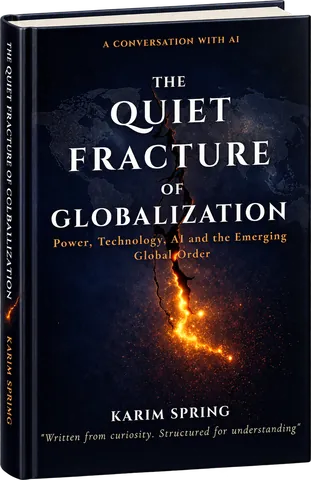
The rest of the chapter, and the whole book, is in The Quiet Fracture of Globalization.